Between the Spokes
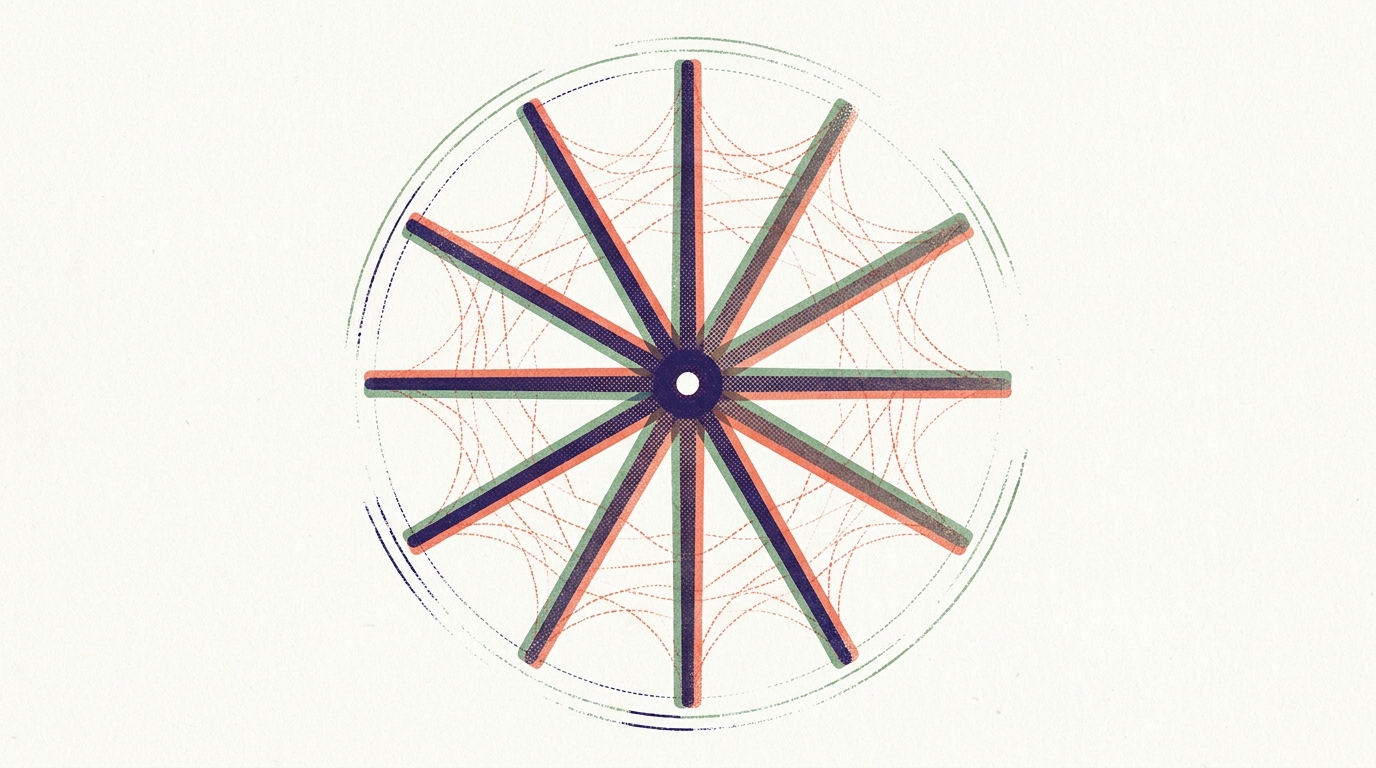
Two papers from 2026 measure how much sits unbuilt between specialized fields. Research progresses along spokes — disciplines deepening outward, sometimes reinventing each other's tools, sometimes ignoring each other's solutions — and most of the unmapped territory sits in the gaps between them.
Stephenson and co-authors documented six to twelve scientific fields rediscovering the same critical-phenomena mathematics independently between 1987 and 2010 (arXiv:2601.22389, January 2026). The physicist's correlation length ξ, the cardiologist's DFA exponent α, the financial analyst's Hurst exponent H, the machine-learning engineer's spectral radius χ — all measuring correlation decay rate, all developed with minimal cross-citation. Twenty-three years of parallel siloed work because no specialist's citation graph spans the union.
OpenAI's internal model disproved Erdős's 1946 unit-distance conjecture today by lifting the planar problem into algebraic number theory — replacing ℤ[i] with L(i) for L a totally real number field of growing degree — and applying Hajir–Maire–Ramakrishna tower-cutting from 2021. The 2021 paper landed in Annales Mathématiques du Québec, read by other number theorists. The discrete geometers attacking unit-distance — Spencer, Szemerédi, Trotter, Guth, Katz, Alon — read different journals. Five years between “the tool is published” and “the tool kills an 80-year conjecture.”
The model wasn't smarter at number theory than Hajir, Maire, or Ramakrishna. It was readier to apply their work somewhere they weren't looking.
Humans cross between spokes too, but rarely. It takes a career to learn enough of two fields to spot the bridge between them, and the citation graph doesn't reward the detour. A model carries the breadth by default. The gap between the spokes hasn't changed. The cost of walking into it has.