Clairic against Haiku 5.5 on extraction
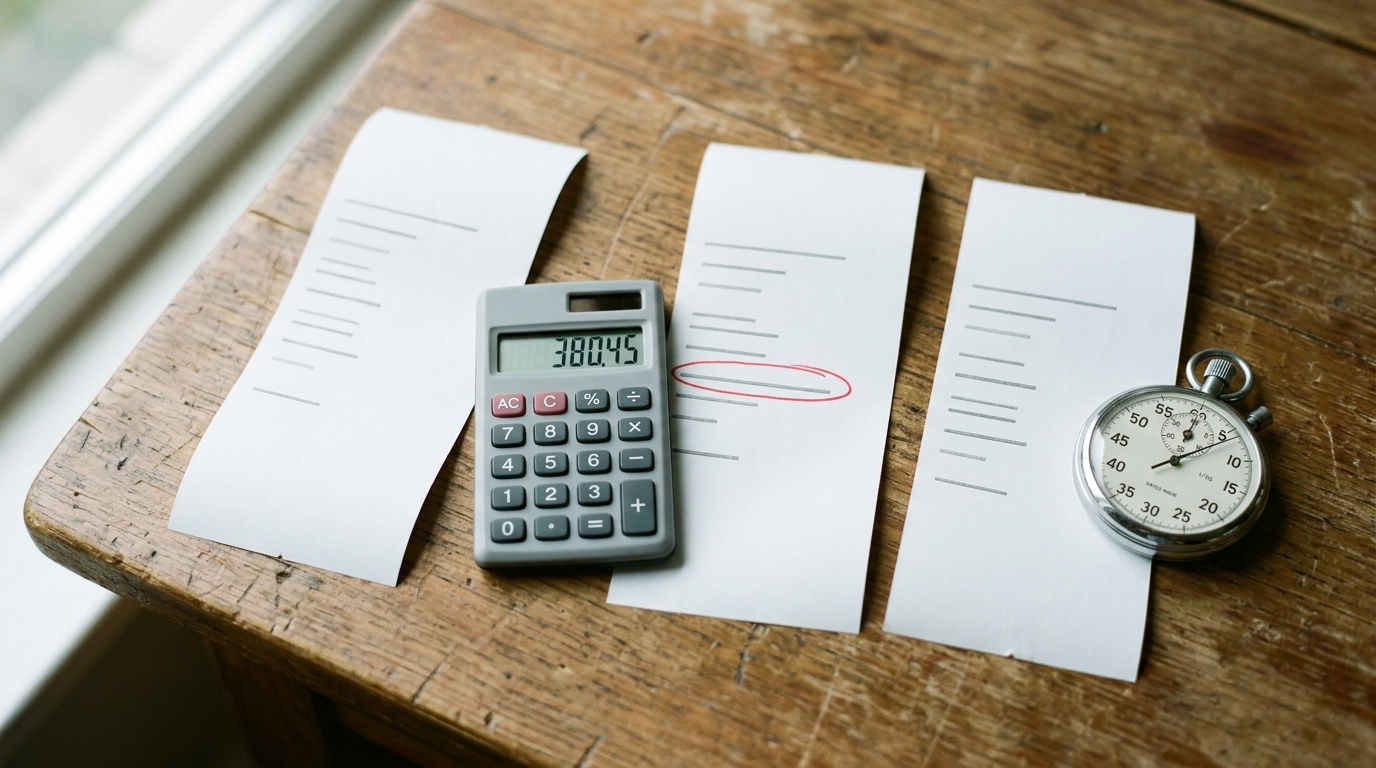
Clairic costs about a quarter of what Haiku 5.5 costs per extraction, and it answers in under half a second. It was also less accurate: 82% of the text fields it answered were right, against 95% for Haiku.
Clairic is a preview model from Cloudflare, hosted on Workers AI. It reads its input in one pass and generates no output tokens, so you pay only for input. Haiku 5.5 is a general LLM. It reasons before it answers and bills for output. Both were asked for the same typed fields: a total, a date, a name, a list. Each field carried a plain-language instruction.
I wrote 25 text items and 8 images of receipts and tables. The items were built to be hard: totals that need arithmetic, a weight in pounds and ounces, a date count, fields that should come back null because the text never states them, and misspelled vendor names on the images. I kept the answer key in a file Haiku never read. Haiku ran as a separate headless process. Clairic ran through its REST endpoint. Each field was scored right or wrong, with a tolerance for rounding.
On the text set, Haiku got 36 of 38 scalar fields right and Clairic got 31. On the images, Haiku got 27 of 27 and Clairic got 24.
Clairic's misses fell into four kinds. The first is arithmetic. It returned a total of 387.58 where the correct figure was 380.45. A tank that is 3/8 full at 40 litres, with 12.5 litres added, should be 27.5 litres; it returned 32.5. The second is unit conversion: 3 lb 4 oz is 1.47 kg, and it returned 1.52. The third is counting. It returned 18 days where the answer was 17, and it read "a quarter to one" as 00:45 rather than 12:45. The fourth is null. A receipt with no discount line got a discount of 0, with a 41% chance that the value was null. On the images, it misspelled three vendor names: "CORNER BERYERY", "HBOR HARD" and "LAKSIDE PH". The numeric fields on those same receipts were all correct. One of them, an amount due, appears nowhere on the page.
Clairic returns a confidence score with each answer. It was low on four of its seven wrong text answers. The wrong total came back at 0.0003. Two wrong answers, the discount and the day count, came back confident. A threshold on confidence would catch some errors and miss others.
Haiku's two misses were different in kind. It answered 0 for the absent discount, and it wrote a sentence where the correct answer was null. A stricter scorer counts both as wrong. A reader could count them as right.
Clairic billed $0.10 per million input tokens and nothing for output. That came to about $0.00002 per text item and $0.0001 per image. Haiku 5.5 bills $0.10 per million input tokens and $0.50 per million output. Its raw cost works out to about $0.0001 per text item in the batch I ran. For images it works out to about $0.00015 before image tokens, which I did not measure. Haiku answered all 25 text items in one call, which took 20 seconds. Clairic's median call took 0.4 seconds.
Clairic reads values off the text and does not reason. Haiku reasons, and that accounts for most of the cost and most of the delay. It also accounts for the date count and the unit conversion that Clairic got wrong.
The set is small. Eight images and 25 text items are enough to see the pattern and not enough to rank the two systems by a few points. The items lean on arithmetic, which Cloudflare's own post says Clairic is weak at. On plain reads it did well: it returned the timezone-bearing arrival time, the accented name and the list of visit dates correctly. The two estimate items fell inside the 80% interval on both systems, but I set those true values myself, so they say little.
One process note. My first Haiku run went through a subagent. The subagent's prompt picked up my session context, and that context contained the answer key. I discarded those results and reran both sets as clean headless processes. The numbers above come from the clean runs.
If the answer is read straight off the text and a wrong value is cheap to catch, Clairic is the cheaper choice. Keep arithmetic in code, or send it to a model that reasons. At these prices, $1 buys about 40,000 Clairic text items or about 10,000 Haiku text items.