Don't Binarize the Query
In the previous post I measured how well a small embedding model survives compression. Tim Kellogg replied with a pointer to how Exa builds their vector database: quantize to one bit, do the scan on CPU, then refine without the quantization. Which sent me back to a number in my own results that I had explained wrong.
Two codecs stored exactly one bit per dimension, in exactly 128 bytes per vector, and one scored 0.7018 while the other scored 0.6772. I attributed the gap to the codecs — one uses Lloyd-Max scalar quantization, the other uses sign hashing, so of course they differ.
That was wrong. The codecs were barely involved. The gap was that one of them binarized the search query and the other didn't.
Mine was the one that did. So this post is partly about a bug I shipped, and mostly about why that bug is everywhere.
The setup, briefly
Semantic search stores a vector per document. Binary quantization shrinks those vectors by keeping only the sign of each number — positive or negative, one bit each. A 1024-dimension vector goes from 4,096 bytes to 128. Thirty-two times smaller, and on the model I tested it costs about 1.5% of search quality.
To search, you embed the query and compare it against every stored vector. And here is the fork in the road that this whole post is about:
- Symmetric: binarize the query too, then count how many bits differ between the query and each document. That count is Hamming distance, and computing it is spectacularly fast — an XOR and a popcount instruction, both of which CPUs do natively.
- Asymmetric: leave the query as full-precision floats. Score each document by taking a dot product between the float query and the ±1 values the document's bits stand for.
The asymmetric version is free. Not cheap — free. The index is byte-for-byte identical either way; only the document side is stored, and it's still one bit per dimension. There is exactly one query per search, and you never store it. Binarizing it buys you nothing at all.
What it's worth
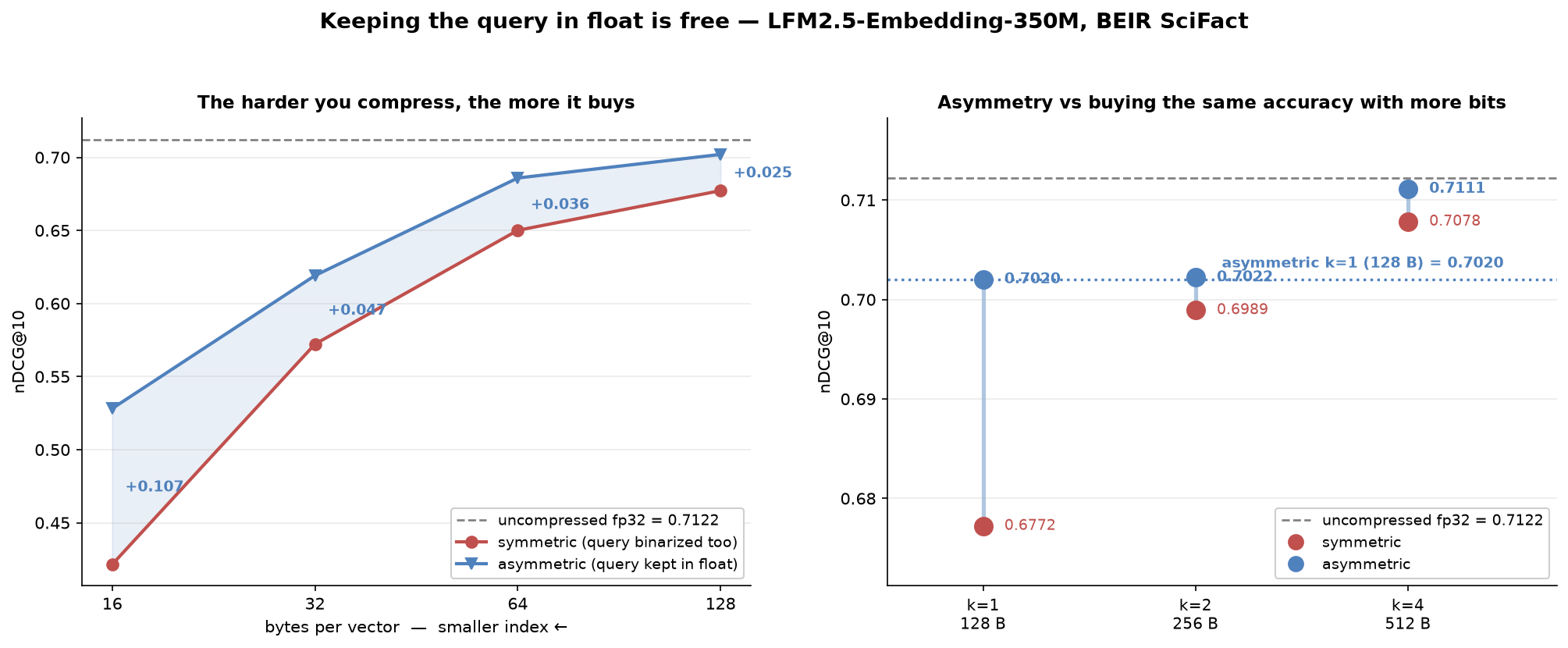
Measured on BEIR SciFact with LFM2.5-Embedding-350M, same encoded index, only the query side changing:
| Index size | Symmetric | Asymmetric | Gain |
|---|---|---|---|
| 128 B/vector | 0.6772 | 0.7020 | +0.025 |
| 64 B/vector | 0.6501 | 0.6859 | +0.036 |
| 32 B/vector | 0.5722 | 0.6191 | +0.047 |
| 16 B/vector | 0.4214 | 0.5282 | +0.107 |
The left panel shows the gap widening as the index shrinks. That direction is predicted. Dong, Charikar and Li framed it in 2008: the error in a sketched similarity has two sources, uncertainty about the document and uncertainty about the query, and asymmetry removes one of them. At moderate bit-depth that's worth roughly a factor of two. Down at one bit per dimension, where the document side is at its crudest, the query side is carrying proportionally much more — the RaBitQ authors ablate exactly this and find the query-precision effect grows to something closer to six- or eight-fold. Which is to say: asymmetry matters most precisely where binary quantization operates.
The right panel answers the more practical question. My library offers a "stacked" mode that spends more bits per vector to improve accuracy — so is asymmetry worth more or less than simply buying more bits?
| Config | Index size | Symmetric | Asymmetric |
|---|---|---|---|
| k=1 | 128 B | 0.6772 | 0.7020 |
| k=2 | 256 B | 0.6989 | 0.7022 |
| k=4 | 512 B | 0.7078 | 0.7111 |
Asymmetric at 128 bytes (0.7020) beats symmetric at 256 bytes (0.6989). Turning it on is worth more than doubling the index. And once you have it, the k=2 configuration is pointless — 0.7022 for twice the storage of 0.7020. Stacking and asymmetry fix the same problem, which is why the gain collapses from +0.025 to +0.003 the moment you stack.
So why isn't everyone doing this?
This is where it gets strange. Exa published their version of this on December 17, 2024 — nineteen months ago, which in this field is a geological era. Their post explains the technique clearly and reports a large speedup from it.
It went nowhere. I searched Hacker News for every story from exa.ai/blog: seventeen results between 2024 and 2026, and this post is not among them. Their Launch HN got 412 points. This one was never submitted.
But "nobody noticed the Exa post" is a shallow answer, because the technique was old when Exa wrote about it. Jégou, Douze and Schmid described exactly this in 2011, in the paper that introduced Product Quantization. They called the two options symmetric and asymmetric distance computation, proved that the asymmetric version has half the error bound of the symmetric one, showed the two cost the same, and wrote plainly: "one should then use the asymmetric version, which obtains a lower distance distortion for a similar complexity." They measured that a 48-bit asymmetric code matched a 64-bit symmetric one.
Their headline measurement, on 64-bit codes over the GIST dataset: recall@100 of 0.446 symmetric against 0.652 asymmetric — a 46% relative improvement, for 16.8ms against 17.2ms of query time. Same codes, same budget, half a millisecond apart.
That was fifteen years ago. So the real question is not why one blog post got no traction. It's why a result that old, that clear, and that free was sitting unused in my code in 2026.
It did become standard — somewhere else
The first half of the answer is that my framing was wrong. Asymmetric scoring is thoroughly standard, inside systems built by people who specialize in this:
- Lucene and Elasticsearch ship it in BBQ ("Better Binary Quantization"). Lucene's own javadoc describes "asymmetric quantization of vectors, where query vectors are quantized to half-byte (4 bits) precision … and then compared directly against the single bit quantized vectors in the index." Documents get 1 bit, queries get 4. Elastic says it "significantly increases search quality at no additional cost in storage."
- Qdrant added an explicit asymmetric mode in v1.15.0 (July 2025), and published the best ablation I found: +8 to +12 percentage points of recall across ten datasets, at identical compression.
- Milvus uses a full-precision query by default in its RaBitQ index.
- FAISS has defaulted Product Quantization to asymmetric for over a decade. The enum in the header reads
ST_PQ, ///< asymmetric product quantizer (default).
Meanwhile the academic side had converged too: RaBitQ (SIGMOD 2024, published seven months before the Exa post) is asymmetric by construction, and is what most of those engines actually adopted. Its authors state the case against sign hashing in one sentence: "SRP maps both the data and query vectors to bit strings, which introduces error from both sides… RaBitQ only introduces the error from the side of the data vector." SRP is the family my library belongs to.
So the technique diffused fine. It just diffused into database internals, where a working engineer building retrieval doesn't see it.
An API signature, not an oversight
FAISS was written by the same group that wrote the 2011 paper. It defaults PQ to asymmetric. And its documentation for binary indexes says:
"Asymmetric search (ie. database vectors are compressed but the queries are not) is not supported directly with binary indexes."
The authors of the asymmetric result shipped a binary index that can't do it. Not because they disagreed with themselves — because of a type signature. The binary index API takes uint8 for the database vectors and uint8 for the query. There is no argument slot that a float query fits into.
That pattern repeats everywhere binary vectors show up:
- pgvector's Hamming operator
<~>is defined bit-to-bit. To use it you callbinary_quantize()on the query. - sqlite-vec's
vec_distance_hamming()is documented as "only valid for bitvectors." - Weaviate is asymmetric for Product Quantization and symmetric for Binary Quantization — the same product, split by which code path you land in.
Binary vector search inherited its interface from a different problem. Hamming distance comes from hashing and near-duplicate detection, where both sides genuinely are bit strings and symmetry is the whole point. When embeddings got binarized, they arrived into an API shaped for that older job — and the asymmetry wasn't rejected on the merits. It was unrepresentable. You can't pass a float query to a function whose signature is two bit strings.
My library did exactly this. The internal function is hamming_distances(codes, query_code). Both arguments are packed bits. I didn't consider and reject keeping the query in float; the shape of my own helper never raised the question.
What the tutorials teach
The layer most engineers actually learn from — the HuggingFace and sentence-transformers guides, the vendor how-tos — does something subtler than getting it wrong. It gets the shape half right.
The canonical recipe, from the HuggingFace binary quantization post (March 2024), is two-stage: retrieve with Hamming distance, then rescore the shortlist using the float query. That rescoring step is asymmetric scoring. It's there, it works, and it's genuinely good advice.
But it runs after retrieval. The candidate list has already been chosen by the symmetric stage, and rescoring can only reorder what that stage surfaced — never recover a document it missed. Recall stays capped by the weakest link.
How much does that cap cost? The mixedbread team, who co-authored the canonical tutorial, measured it themselves. On TREC-COVID with symmetric retrieval alone and 10× oversampling: "We loose around 53% of the performance." With the asymmetric rescore added back: "we retain 99%."
They measured that symmetric Hamming costs roughly half the quality, published the number, and still ship symmetric Hamming as stage one — because the index is a faiss.IndexBinaryFlat, and that is the only thing it can do. The API constraint again, propagating from a C++ header into the recipe that everyone copies.
What to actually do
- If you binarize embeddings, don't binarize the query. Score the float query against the stored bits directly. It's free and, on my data, worth more than doubling the index.
- Still rescore. Asymmetric scoring closed my two-codec gap but did not reach uncompressed quality on its own (0.7020 against 0.7122). A small exact-rescore pass still does the last stretch — 25 candidates was enough on a 5,000-document corpus.
- Check what your engine does. Elasticsearch/Lucene BBQ and Milvus RaBitQ are asymmetric already. Qdrant needs opting in. pgvector and sqlite-vec can't, so budget for rescoring.
- Watch for the API tell. If the distance function's signature takes two bit strings, asymmetry has been designed out and you'll need your own scoring path.
The honest caveats
One dataset, one model, one seed, 300 queries. The direction is consistent and the mechanism is well established, but the magnitudes are mine, not universal. Qdrant's +8–12 points of recall is the number with real breadth behind it.
I nearly wrote here that symmetric Hamming at least buys you speed, since XOR-and-popcount is much faster than a float dot product. That is true of my implementation and false of the technique. RaBitQ keeps the query at four bits and bit-decomposes it, so asymmetric scoring costs four AND-plus-popcount passes instead of one — a constant factor, with bit-parallelism, SIMD and GPU-friendliness all intact. Their asymmetric index measured faster than Product Quantization, because popcounts beat RAM-resident lookup tables. Asymmetry does not mean giving up popcount. My float-LUT version gives it up; a better implementation would not.
There is a real case for symmetric, though, and it is worth stating properly: when you are comparing two stored items rather than a query against storage — deduplication, clustering, building a neighbour graph — there is no high-precision side to keep. Symmetry is not a compromise there, it is the problem. Hamming distance came from that world, which is a good part of why it arrived in vector search shaped the way it is.
And Exa's post, whatever its reception, is where I got this. They describe the approach as novel, which is a stretch — the lineage runs back to 2011 and RaBitQ beat them to press by seven months. But they explained it clearly enough that a reader could go implement it, which is more than the papers managed for fifteen years.
The code
Implementation and measurements are in oaustegard/remax: search_asymmetric() on both quantizers, reading the same index encode() already produces — no re-encoding, no migration. Scoring uses a byte-level lookup table (precompute the partial dot product for all 256 possible byte values, then gather and sum) so it costs one lookup per byte instead of one multiply per dimension, and never materializes the dense vector that would defeat the compression.
The benchmark is bench/asymmetric_lfm25.py; the numbers above are in bench/results/lfm25_asymmetric.json.
A closing note on how this got found, because I nearly told it wrong. I did not notice the discrepancy myself. The 0.7018 and the 0.6772 sat next to each other in a table I had written, with an explanation I had made up, and I would have left them there. What happened instead is that I published the results, Tim Kellogg read them and pointed at how somebody else had solved the same problem, and the mismatch became obvious the moment I had his reference to compare against.
The useful version of that is not "keep the benchmarks that embarrass you." It is: publish the numbers with the explanation you believe, in public, where someone who has seen more of the field than you can tell you the explanation is wrong. A wrong reason attached to a correct measurement is invisible from the inside. It took someone else three minutes.